
AgeVolt for people in housing estates - where to charge an electric car if you don't have your own garage?
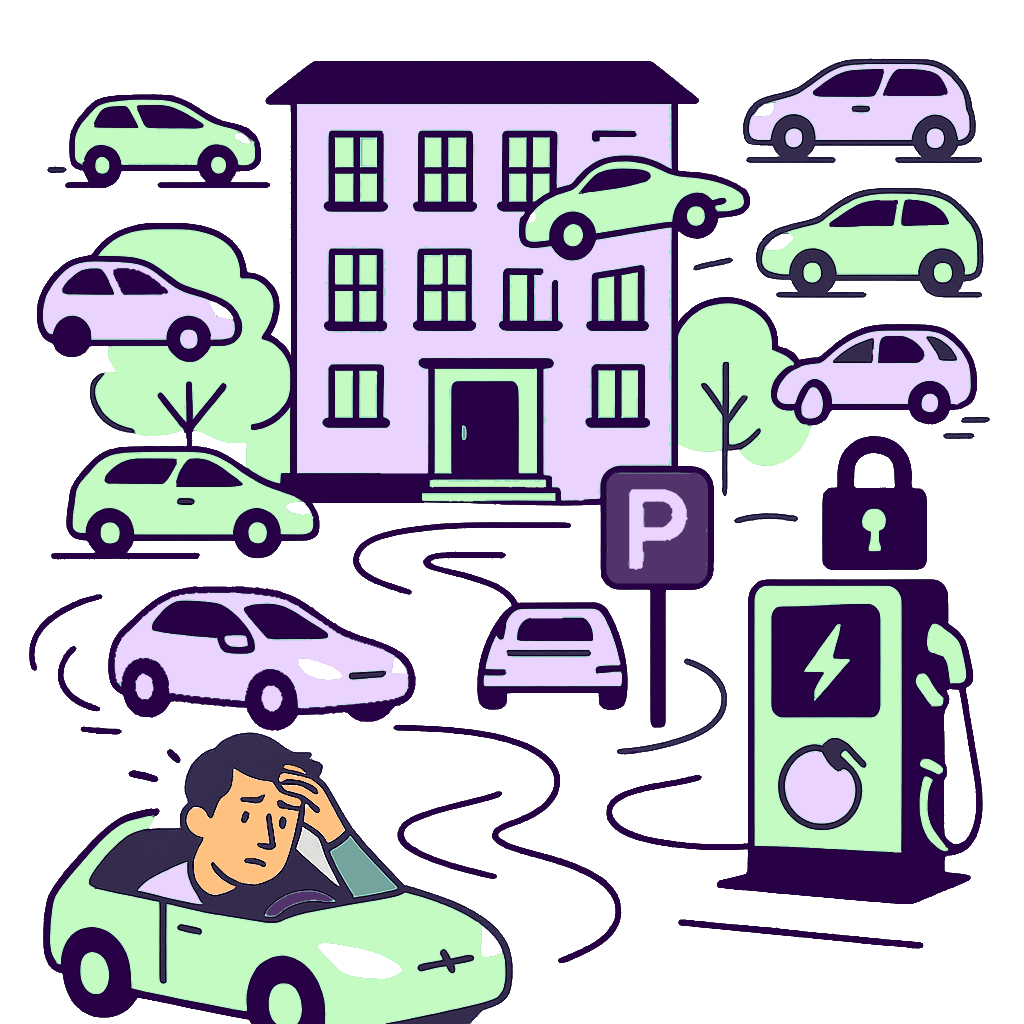
Problem
- The eternal battle for parking – even if you find a spot, the charger isn't there.
- There is no overnight charging - the public charging station only allows you to park until it charges, then you pay a fine.
- High tariffs – nearby fast chargers cost more than gasoline and increase the cost per km.
- Corporate EV without data – the employer only reimburses what you prove; you have no meter or invoice at home.
- No coordination with neighbors or the city - everyone solves the problem on their own, so chargers are not increasing and e-mobility is stagnating.
Possible consequences
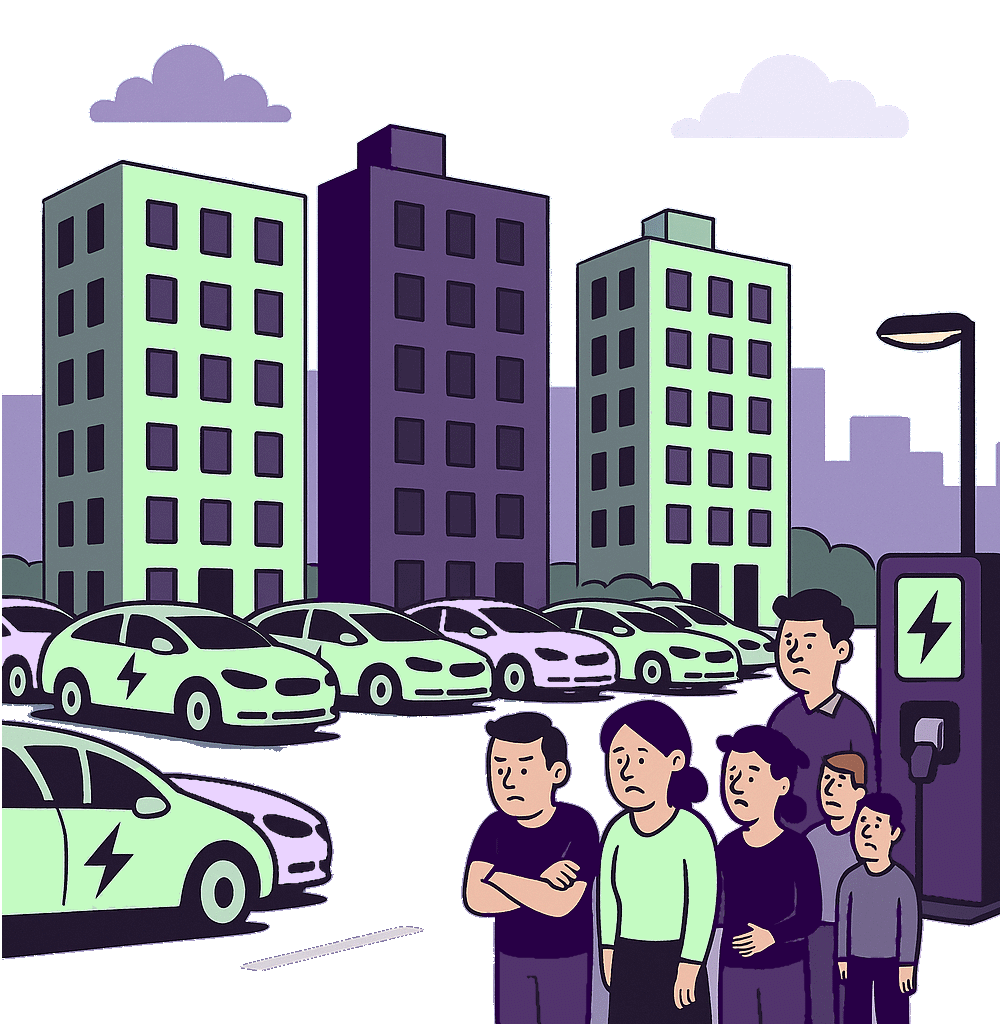
If housing estates are left without accessible charging, the transition to electromobility will stall in large cities , where it could bring the greatest environmental benefits. Residents are postponing the purchase of an electric car because the real costs of fast chargers are higher than for a combustion car and the convenience of "plug in at night - leave in the morning" is unattainable.
Employers switching to corporate EVs face resistance from drivers: home charging is not measurable, refunds are handled as flat rates, and the best motivated employees prefer to stick with diesels. The city's clean zone policy is thus losing support from its own residents and the municipality is unnecessarily lagging behind in meeting its climate goals.
Inequality is deepening: residents of single-family homes use cheap photovoltaic charging, while residents of apartment buildings pay the most expensive kWh in the network. Electromobility is turning into a premium benefit for a select few - and its reputation among ordinary people is declining. Without coordination between the city, apartment building managers and commercial parking lots, a small "parking inconvenience" becomes a strategic obstacle that hinders innovation and green investments in the entire region.

Solution
The housing estate is not a dead end for electromobility; it just lacks infrastructure that respects the reality of apartment buildings and the city's parking policy. AgeVolt builds the solution on two pillars – smart stations connected to the existing common connection of the apartment building and connections to public spaces (street lamps, parking lots of shops or companies).
Charging on the apartment building's own property
A single cable loop is led out of the main connection of the common consumption , on which the SmartBase module is mounted. The station is physically mounted outside near the parking space; therefore, the SmartBase does not extend into the apartment risers or apartment circuit breakers. The control follows the common consumption circuit breaker , so that the elevators and corridor lighting always have priority; when the consumption increases, the chargers' power is gradually reduced, but charging does not stop.
Each apartment gets its own account in MyAgeVolt – the portal measures the kWh consumed, assigns a price and generates a document for the administrator. Residents pay the same tariff as if they were charging in a family home , and do not have to deal with new paperwork or a separate connection.
City-owned parking lots
If the spaces in front of the house belong to the city, AgeVolt mediates a tripartite agreement: the apartment building supplies the connection point (connection), the city provides the land, and AgeVolt supplies the poles . The stations are connected either to the apartment building's connection (the cost is divided between interested parties) or to public lighting - in this case the city collects part of the revenue, but residents receive a residential tariff valid from evening to morning. MyAgeVolt can automatically switch prices: the same charger is a regular public AC station during the day, and cheap home charging at night.
Commercial parking lots as a nighttime refuge
Shopping centers, supermarkets, and office buildings have dozens of spaces available after 10:00 p.m. MyAgeVolt allows their owners to "tap off" part of their capacity to residents - the application publishes a window of 10:00 p.m. to 6:00 a.m., the price is set to the domestic tariff, and the system guards access only for vehicles registered in the vicinity. The owner still earns money, the resident charges cheaply, and the municipality does not have to build a duplicate.
Corporate EV and smart accessories
Those who use a company car should pack a Smart Cable Charger - a portable cable that measures energy even outside the home station. The employer receives accurate kWh, so they reimburse the real cost instead of an expensive flat rate , and the driver does not have to refuel at overpriced DC stations.
Why is it worth it?
– loop cables and a shared circuit breaker cost a fraction of the price of a new connection; the return on investment of the station (including installation) in an apartment building is similar to that of a single-family home.
– one infrastructure serves residents, visitors and the city's fleet, so dozens of unused points are not built.
– MyAgeVolt connects lamps, retail, apartment buildings and highway DC hubs into a single map; residents can see availability, price and reserve a spot.
– the housing association or city only pays AgeVolta a small commission on sales; if a better model comes along, the hardware and data remain with the city owner.
The result: even a block of flats can be "charged at night", residents won't spend half their paycheck on fast chargers, and the city will move towards zero emissions without digging up every street.